What To Expect When A Loved One Enters Hospice (from The Gospel Coalition)

God sure knows when to reinforce my calling (a long-term goal and possibly a retirement project) lest I get distracted and focus on other things. I stumbled upon this article from The Gospel Coalition a couple of days ago, and this is exactly what I needed for the hospice project I am planning to propose to my siblings. I thought I’d share it here as well to help those who are going through a similar situation. 🙏

Original Article Link: https://www.thegospelcoalition.org/article/expect-loved-one-hospice/


“What To Expect When A Loved One Enters Hospice”

By Kathryn Butler

I recently lost a dear friend to cancer. She’d struggled with treatments and recurrence for years, and when her doctor finally said the heavy word “hospice,” she and her family were neither surprised nor despairing. As Christians, they drew comfort from the assurance she’d be with the Lord after she took her last breath (Rom. 14:8; 2 Cor. 4:17–18).

And yet, although my friend embarked on her hospice journey with full acceptance, none of her family was prepared for the tumult of emotions her final days incited. They trembled and choked back tears when she bolted upright in agitation. When she no longer responded to their voices, they nursed the ache of loss. Throughout, they struggled to reconcile the grim realities of death with the mother, sister, and wife they so cherished.

Families with loved ones in hospice all too frequently weather such storms. As the wages of our sin (Rom. 6:23), death is by nature harrowing, even when anticipated. We weren’t meant for death, and those of us who encounter it often struggle with lingering grief, confusion, and regret afterward, especially when it steals away someone we dearly love.

With a million and a half people in the U.S. receiving hospice care annually, many families will walk this troubling road, suffering doubts and heartache along the way. How do we shepherd caregivers and families as they aim to love the dying? How do we walk with them through the valley of the shadow of death, reminding them all the while of the Good Shepherd whose love covers them when the light dwindles (Ps. 23:4)?

𝗪𝗵𝗮𝘁 𝗛𝗼𝘀𝗽𝗶𝗰𝗲 𝗜𝘀

Misunderstandings about hospice abound and contribute to the pain families bear. Many people equate hospice with “giving up” on a loved one. Others confuse it with physician-assisted suicide and euthanasia. Still more have an accurate idea of hospice but can’t bring themselves to say goodbye to someone they can’t fathom living without.

To clarify, hospice care seeks to minimize pain and suffering at the end of life among those with terminal illnesses. A multidisciplinary team, usually comprised of physicians, nurses, social workers, chaplains, and health aides, provides medical care as well as spiritual and social support with a focus on symptom control and quality of life, rather than on cure. Although we often associate hospice with cancer, the most common qualifying diagnoses are severe dementia, emphysema, and heart failure.

For people with a life expectancy of months, hospice services often begin as regular home visits from nurses, social workers, and home health aides to ensure patients are stable and comfortable. As the illness advances, support increases, and eventually the dying require continuous care at the bedside and frequent doses of medications to ameliorate pain, anxiety, and air hunger. In the home, this care often falls to loved ones, which can be emotionally traumatic. In such circumstances, a hospice house, where staff nurses monitor patients 24/7, may be a better alternative.

People can only receive hospice services if they have a life expectancy of six months or less. Such patients, after consultations with doctors they trust, accept that further interventions for a cure would be futile (e.g., a cancer has metastasized to other organs and treatment options have run out). In hospice, medical care continues, but that care shifts to focus on lessening symptoms rather than eradicating the disease.

Studies suggest that rather than indicating caregivers have “given up” on patients, this shift in care can actually increase the life expectancy of terminally ill patients for up to three months. In our highly technological medical system, accepting the inevitability of death has a clear, measurable benefit.

It also has a biblical precedent. Although Scripture directs us to honor life (Ex. 20:13), it also reminds us our times are in God’s hand (Ps. 31:15). Like the grass of the field, we wither and fade (Isa. 40:7–8); until Christ returns all of us will succumb to death (Rom. 5:12). When we deny our mortality and chase after treatments that don’t promise cure, we dismiss God’s grace in Christ and the power of his resurrection. Christ has transformed death, swallowing it up in victory (1 Cor. 15:54) such that, as the Heidelberg Catechism aptly states, it’s no longer “a payment for our sins, but only a dying to sins and an entering into eternal life.”

𝗪𝗵𝗮𝘁 𝗛𝗼𝘀𝗽𝗶𝗰𝗲 𝗜𝘀𝗻’𝘁

While hospice reflects biblical teaching, the same can’t be said for euthanasia or physician-assisted suicide (PAS). Families facing hospice for a loved one may confuse these practices, especially given the terminology of “Medical Aid in Dying,” or MAiD, now adopted in Canada and used in the U.S. with increasing frequency. While in hospice, death occurs secondary to an underlying illness, in MAiD, terminally ill patients seek medical means to deliberately end their lives.

In euthanasia, for example, a healthcare provider administers a lethal dose of medication––often an injection––on a patient’s request. Similarly, in PAS, doctors prescribe a dose of pills for a patient to take on his or her own. In both cases, the “aid in dying” isn’t symptom support but rather a lethal dose of medication.

As the legalization of PAS has steadily increased in the U.S. over the past 20 years, it’s crucial to understand its distinction from hospice. In hospice, the aim is to alleviate suffering from futile or excessively burdensome measures. People can “graduate” from hospice; if a patient unexpectedly improves and is no longer deemed terminal, clinicians rejoice and hospice services are discontinued. PAS, by contrast, involves the active taking of another life with the explicit goal to end it, and it violates God’s Word (Ex. 20:13).

𝗪𝗵𝗮𝘁 𝘁𝗼 𝗘𝘅𝗽𝗲𝗰𝘁

The knowledge that hospice care aligns with biblical teachings can provide solace to families. Yet even with this consolation, watching a loved one die can be crushing. Many families embark on this journey with confidence, only to find the unsettling details of dying overwhelm them.

The following common changes may occur when death is near, which may trouble those at the bedside:

As a dying person’s organs shut down, 𝗯𝗿𝗲𝗮𝘁𝗵𝗶𝗻𝗴 𝗿𝗲𝗳𝗹𝗲𝘅𝗶𝘃𝗲𝗹𝘆 𝗯𝗲𝗰𝗼𝗺𝗲𝘀 𝗿𝗮𝗽𝗶𝗱 to remove excess acid from the bloodstream. As such breathlessness worsens anxiety and fatigue, nurses will administer a narcotic (usually morphine) or a sedative to help slow the breathing.
Intestines shut down as death nears. 𝗣𝗲𝗼𝗽𝗹𝗲 𝘄𝗶𝗹𝗹 𝗵𝗮𝘃𝗲 𝗻𝗼 𝗮𝗽𝗽𝗲𝘁𝗶𝘁𝗲, and although loved ones may worry about starvation, forcing them to eat or drink leads to vomiting or abdominal cramping.
In the setting of dehydration close to death, 𝘁𝗵𝗲 𝗺𝗼𝘂𝘁𝗵 𝗮𝗻𝗱 𝗹𝗶𝗽𝘀 𝗱𝗿𝘆 𝗮𝗻𝗱 𝗰𝗿𝗮𝗰𝗸. Hospice care workers provide moist mouth swabs to counteract the discomfort.
𝗔𝗴𝗶𝘁𝗮𝘁𝗶𝗼𝗻, 𝗱𝗲𝗹𝗶𝗿𝗶𝘂𝗺, 𝗮𝗻𝗱 𝗵𝗮𝗹𝗹𝘂𝗰𝗶𝗻𝗮𝘁𝗶𝗼𝗻𝘀 are common near death and can be especially upsetting to witness. In the mildest cases, patients will see people from their past, which may alarm onlookers. In the most distressing, the dying will suddenly panic or lash out at others with cruel insults. Clinicians give medications to calm patients and avoid such outbursts, but when they do occur, delirious patients’ words can deeply hurt those they love. In such moments, we can reassure families that death affects the mind as well as the body and that their loved ones are unaware of their actions. Agitation near death reflects the disease, not the patient’s true thoughts and feelings.
People 𝗴𝗿𝗮𝗱𝘂𝗮𝗹𝗹𝘆 𝗹𝗼𝘀𝗲 𝗰𝗼𝗻𝘀𝗰𝗶𝗼𝘂𝘀𝗻𝗲𝘀𝘀 as death nears. However, in the days to hours before death, some suddenly awaken and carry on clear, coherent conversations. Called “𝘁𝗲𝗿𝗺𝗶𝗻𝗮𝗹 𝗹𝘂𝗰𝗶𝗱𝗶𝘁𝘆,” this phenomenon is poorly understood but well documented and can confuse loved ones who mistake the sudden clarity for clinical improvement. A good approach is to treat these moments as gifts from the Lord, offering loved ones a final glimpse of the person they’ve treasured.
Even when the dying are unresponsive, evidence suggests 𝘁𝗵𝗲𝘆 𝗰𝗮𝗻 𝘀𝘁𝗶𝗹𝗹 𝗵𝗲𝗮𝗿, with their brains responding to sounds as distinctly as do awake, healthy individuals. This can provide families with enormous comfort, as it means their loved one may still hear and understand their words. Encourage families to speak to their loved one, to read Scripture, to pray aloud, and to sing hymns and favorite songs. Such connection can provide much-needed closure and solace to the living, and minister lovingly to the dying.
In the last 24 hours, 𝘁𝗵𝗲 𝘀𝗸𝗶𝗻 𝘁𝘂𝗿𝗻𝘀 𝗺𝗼𝘁𝘁𝗹𝗲𝗱 𝗮𝗻𝗱 𝗯𝗹𝘂𝗶𝘀𝗵, especially in the hands and feet. This is normal and signals the circulatory system shutting down.
The last few hours of life are often marked by 𝗱𝘆𝘀𝗿𝗲𝗴𝘂𝗹𝗮𝘁𝗲𝗱 𝗯𝗿𝗲𝗮𝘁𝗵𝗶𝗻𝗴. People will breathe deeply and rapidly for several breaths, then not breathe at all for up to two minutes. Secretions pooling in the airways also create an unsettling rattling sound with each breath. Additionally, relaxation of the vocal cords can produce a sound similar to moaning, even in the absence of discomfort. While these changes are upsetting to witness, at this point patients are unaware of their surroundings and unlikely to experience suffering.
𝗛𝗼𝗽𝗲 𝗘𝗻𝗱𝘂𝗿𝗲𝘀

In addition to the troubling realities outlined above, families of hospice patients may wrestle with questions about the faith and salvation of their loved one. If a loved one isn’t a believer, relatives may urge nurses to withhold sedatives, clinging to hope for a deathbed conversion. If a loved one has proclaimed faith, moments of agitation may raise doubts about the sincerity of that profession.

While their heartache is understandable, to withhold medication and incur unnecessary suffering is neither loving nor compassionate. As solace, we can point families to the thief on the cross (Luke 23:39–43), whom Jesus invited into his kingdom as he was dying. We can reassure them that the Holy Spirit can work in someone’s heart regardless of their capacity for language or cognition, and the Lord can bring all he wills to himself (Eph. 1:3–7). The good news of the gospel declares that salvation depends not on us but on God’s grace––and he can turn every heart he wills from stone into flesh (Ezek. 36:26).

Above all, when families walk alongside a loved one in hospice, they show him or her, as well as surrounding caregivers, the character of Christ.

To abide with another through death is to love in the sacrificial, soul-weary way our pierced Savior loved us first (Matt. 26:38; John 13:34–35; 1 John 4:19). It’s to weep with those who weep (Rom. 12:15) and to bear another’s burdens (Gal. 6:2). It’s to offer a loved one a tangible reminder––perhaps with a hymn heard through the shadows, perhaps with a gentle touch––that God’s love endures forever (Ps. 107:1) and that, in Christ, nothing––not even death––can pry his beloved away from his grasp (Rom. 8:38–39).


When The Pain Lingers

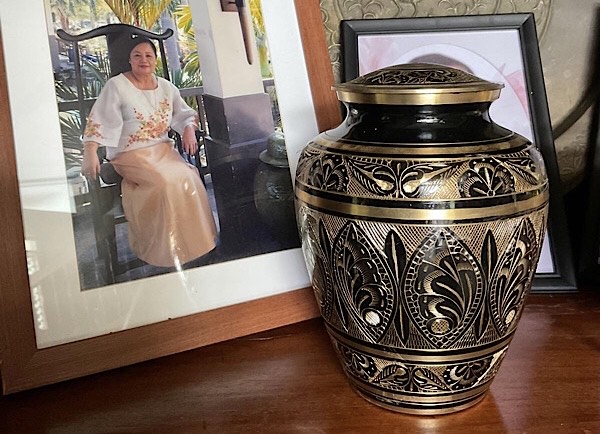
I requested a copy of Mom’s death certificate online today and once again, tears just started streaming down my face as I wrote her death day. It’s been 7 months since Mom passed away, and yet grief still lingers – the pain lingers. Indeed, what they say is true. The pain will never go away. You just learn to move on with your life, but the pain of losing a loved one will always be there. And yes, things will just never be the same.

For today’s blog post, I wanted to write a letter to my Mom just to lessen the pain a little bit. ❤️

“Dear Mommy,

I miss you terribly. I miss your text messages and our long conversations over the phone (not less than 2 hours) just talking about anything. I miss watching movies with you and how we would analyze and make a movie critique even when the movie was not yet finished and make assumptions about how it will end.

I ate pistachios today – your favorite. They were supposed to be a “pasalubong” for you from a relative abroad. Your favorite imported soaps are also still in your cabinet, and I don’t know if I will use them because their scent reminds me of you and makes me miss you even more.

Do you still remember when I was still sleeping with you and Dad until I was 6 years old and how I’d tuck my hand under your armpit and I’d fall asleep right after? I still do that now, but with my husband. lol You probably must’ve thought how weird is this kind of behavior from your youngest child. And yet, you still let me do it.

I hope you were at peace when God took you from us – it was my only prayer while you were at the hospital. Losing you is a tragedy that doesn’t seem to have an ending. We may not agree on certain things, but I want you to know that I am deeply sorry if there were times when I hurt your feelings.

It was never my intention to hurt you, and all I ever wanted was to love you like how you wanted to be loved. You will always be the best Mom for me. And it is because of you that’s why I am who I am today.

Oh Mom, how do you make this pain more tolerable? I wish I had your wit and your wisdom. You seem to have an answer and a solution to everything. Everyone in the family confided with you when it came to their problems and sought your advice.

I was also hoping you’d still get to see your grandkids, my future children (if God wills it I still bear a child). But, I guess that will no longer happen. Losing you is very painful, and I am not sure when will I be grieving. The only consolation I have now is that you’re no longer suffering from pain.

Help me to be brave like you, Mom. And yet I know you will tell me to trust God because He is the only one who sees everything and that He is always in control.

Thank you for everything, Mommy. I will cherish all the memories we’ve had with you – the good and the bad. I may sometimes wish that I’d be with you sooner, and yet I know I still have to look forward to what lies ahead if God will tell me to stay a little longer.

I love you always, and no one can ever replace you in my heart because there is only one person who carried me in her womb and brought me into this world – you.

Always your youngest child,

Nen”


“God will wipe away every tear from their eyes, and death shall be no more, neither shall there be mourning, no crying, nor pain anymore, for the former things have passed away.”- Revelation 21:4


See You In Heaven, Mommy Moo

She would’ve turned 77 today, September 7, 2023. It’s been a week since my Mom passed away last August 27, 2023, just a day after I wrote the article before this. It was a peaceful death because she slipped away in her sleep. She’s finally in a place where there is no more pain and suffering.

It was painful for us, though. But then again, this is life. Death is inevitable. We will all face death one way or the other, sooner or later.

This is the first death in my family, and God has prepared us quite well for it. Though I must say it wasn’t a smooth and easy process. Because there is just no easy way to cope with grief, sadness, and loss.

God prepared our hearts in a way that we were able to face these emotions head-on without breaking apart. He gave us everything that we need, showed us the way we should go, and gave us wisdom on things that truly matter.

I am just grateful for the opportunity to take care of Mom, even though it was very difficult. We couldn’t get another regular Private Duty Nurse (PDN) though we already got one, all thanks to Tita Len. We needed 2 PDNs who will be taking turns watching over Mom every 12 hours. So I took the challenge to learn everything when it comes to providing care to Mom who’s bedridden and had several contraptions attached to her.

Thank You, Ma’am Leah

This is the part where I get to give special thanks to a nurse assistant at the hospital where Mom stayed. Ma’am Leah offered to be Mom’s PDN during the days when she’s able. She taught me a lot of things when it comes to patient care from changing diapers, sterilizing everything, positioning under pads, turning and bathing a bedridden patient, changing wound dressings, changing the NGT tube, and a whole lot more.

I also enjoyed talking to her, and Mom would “shush” us now and then for talking too loud (so sorry, Mom). And every time Ma’am Leah gets carried away by our convo, she would start talking in the vernacular and I just keep on smiling even though I can’t understand most of what she’s saying. lol

We’re both Bicolanas, but she’s from Bacon, Sorsogon. Their language is like Bikol Albay. I came from Bulan and our dialect is already a combination of Bikol Sorsogon and Bisaya or what we call “Bisakol.”

There was one time she said something like “badush” and I was like, “Was she trying to tell me that she’s gay?” Because “badush” is a colloquial term in Manila that means gay. Only to find out later that she meant “badus,” a Bikol Albay word that means “pregnant.” 😀

Second Bicol Home – Daraga, Albay

My Mom’s the only one in the family who’s very fluent in Bikol Albay since my maternal grandparents used to live there for a couple of years when they were young. My Mom also studied in Daraga, Albay during high school (United Institute, Inc.) and college (Bicol University).

My maternal grandparents used to have a house in Daraga, Albay but my grandma decided to give the house and lot to her best friend before relocating here in Bulan, Sorsogon. Yes, my grandma was one of the most generous people I know. Miss you, Mama.

I really would’ve wanted Mom to breathe her last here at home, but it was no longer an option for us. She needed lots of intensive care after going in and out of the ICU twice (1 week for each stay) during the entire 2 months she was at the hospital. She also had a “white coat syndrome,” and this is one of the reasons why she delayed her yearly medical checkup. Seeing her with 5 contraptions attached to her was also just too painful to bear.

Back To My Second Love, Volunteering

So, what to do now with all the intensive caregiving skills I’ve learned from Ma’am Leah? My Dad’s 83 years old already, but he’s still ambulatory. The next thing that popped into my head was my second love – volunteer work. I’ve been volunteering since my college days at UP Diliman as a relief operations volunteer, and then as a family support volunteer in our church. I also joined Minkah Ministries Inc. about 8 years ago because of the volunteering opportunities they offer.

While I was with the organization, I was privileged enough to do volunteer work for the street children and the elderly. I was looking forward to doing volunteer work for cancer patients at the UP PGH’s pediatric ward since it’s also part of Minka’s missionary work. Unfortunately, my schedule didn’t allow it since it fell on a weekday, and I have work.

Fast forward to now, I realized that God intended it to be. I really felt the “tugging” to do volunteer work for cancer patients 8 years ago, but I just didn’t have the opportunity or maybe it was just not the right time.

God gave me a glimpse this year of how caregiving to critically ill patients is done through my Mom. God knew I wasn’t equipped 8 years ago. Though I must say I still have a lot to learn now if I am going to be a regular volunteer for cancer patients here in Bicol.

This was how we communicated with Mom since she’s intubated. And I’m glad that she approved (Mom had high standards) of my caregiving skills all thanks to Ma’am Leah. Konting swabe pa daw. 👍👍😃

Next Faith Goal: Philippine Cancer Society Inc., Bicol Chapter

I did my research and tried searching for organizations that offer seminars and trainings on doing volunteer work for cancer patients. I did find the Philippine Cancer Society Inc., but unfortunately, they do not have a local chapter here in Legazpi City or Sorsogon City.

These are the cities closest to our hometown, and I don’t mind the long travel time as long as the schedule for volunteering falls on a weekend because I am oftentimes a 100% multitasker during the weekdays, I barely have time to breathe. Seriously serious.

But then again, what happened to Mom was a reminder to me and my siblings to pause when the body says it needs rest. I did mention in my previous articles that cancer genes are dominant on my Mom’s side. Only time will tell who among me and my siblings carry the “dreaded” genes.

Agritourism Project As A Retreat Place

This is one of the reasons why I’ve been experimenting with several farm-to-table projects at home that we can incorporate later on into our farm (I’ll share more about this in another article).

I want to make sure I am eating healthy, and the best way to do that is to grow my food. My siblings and I also have plans to pursue an agritourism project, and one of its objectives is to support the local food movement.

This is very timely given our current dilemma on inflation and the increasing prices of basic commodities including vegetables, rice, and meat products. Another objective of our farm project is to become a retreat place for holistic wellness.

Building A Hospice Facility

Then an idea popped into my mind. Since part of our mission and vision for the farm is to be a retreat place, why not include a hospice facility in it? This is what I would’ve wanted for Mom and I know, too, that this is what Mom would’ve wanted knowing how much she enjoyed gardening and being surrounded by nature. It’s not a coincidence that she’s named Eden. 🙂

We lacked the knowledge, training, and manpower to provide Mom what she needed most during her final moments. We weren’t beside her when she passed away, and she was in a hospital room surrounded by strangers, all of whom she barely knew.

We weren’t able to give Mom the ideal final moments I was praying for. But I know God doesn’t want it to end here. I want to make up for these “lost moments” with Mom by helping other families who are going through what we went through.

And the hospice care can be the answer to this. My initial plan is to come up with a 5-bedroom-capacity hospice facility situated inside our farm. We are targeting a farm resort concept, so this will be an ideal setup for terminally ill patients. The rooms must also be big enough for loved ones to stay over and be with the patient until his/her last moments.

Praying for the Completion of Sorsogon Cancer Treatment Center

Who knows, the Philippine Cancer Society (Sorsogon Chapter) might also be founded alongside the hospice facility if God wills it. 😉 I am also very much looking forward to the Sorsogon Cancer Treatment Center that is currently being constructed in Sorsogon City.

I am just grateful for all of these endless opportunities that God has opened because of what happened to Mom. Because these are exactly the opportunities that my siblings and I will be needing in the future.

May God’s Will Be Done Always

These are all huge undertakings (if my Dad and siblings approve), and if Mom’s still alive and I told her about these plans, she’s probably going to tell me that I have very grand and ambitious plans.

To which I would’ve most likely replied with one of my favorite quotations by Edward Everett Hale, “I am only one but I am one. I cannot do everything but I can do something. And because I cannot do everything, I will not refuse to do the something that I can do. What I can do, I should do. And what I should do, by the grace of God, I will.”

And I’ll also include my life verse which is “I can do all things through Christ who gives me strength (Philippians 4:13).” These are all my plans, and yet again “many are the plans of man, but it is the Lord’s purpose that will prevail (Proverbs 19:21).”

If these plans are all God’s plans as well, then I still have how many decades to make them happen. They can happen in our farm or somewhere else, only God knows. 🙂

We weren’t able to give Mom what she wanted, but God intended it for the greater good of more families and not just one. May God give me the wisdom, the right people, and the provisions to be able to pursue all of these endeavors in honor of my Mom.

I thought it best to share everything here in my blog so her memory lives on just in case I suffer from memory loss in the future. lol I can only pray though that the IoT (Internet of Things) is here to stay, but either way, she will always be within us.

Happy Birthday, Mom

We miss you terribly, Mommy Moo. Thank you for all the love, and you will always be in our hearts. Happy Birthday in heaven, Mommy! ❤

P.S. In case you’re wondering, “Mommy Moo (pronounced with a British accent)” is my term of endearment to my Mom. I replaced “Maggie” with “Mommy” in the Netflix movie “The Princess Switch.” 🙂

The Quest In A Vast Space

The Quest: A Vast Space

Naguilian, La Union, Philippines (May 27, 2013)

If only the stars shone the brightest when I met you,
Then I can tell that they’ve aligned for me and you.
If only the skies were as clear and as vast,
Then I could have rejoiced gladly and at last.

But things suddenly changed,
Perspectives here and there were exchanged.
I didn’t realize too as days dragged on,
All the multitudes of emotions I have to ride on.

I could care less if the moments were never the sweetest,
Nor were they precious moments to attest.
But feelings I care not but for what I have learned,
I sure am glad how the cards have turned.

Yes, I did cry.
For yes, I did try.
Funny, how ironic life can be.
A happy ending is not usually what you see.

But should I always be the cynic that I always am?
With a fear to go through yet another sham?
But I hoped for gray skies to clear,
Moments I know I always will hold dear.

So when skies start to become blue,
Believe, for always, they are true.
For though I may have lost you,
Space tells me I will find you.

(Written by: Christine Lailani G. Ginete)