I Have Made A Friend – In Jail

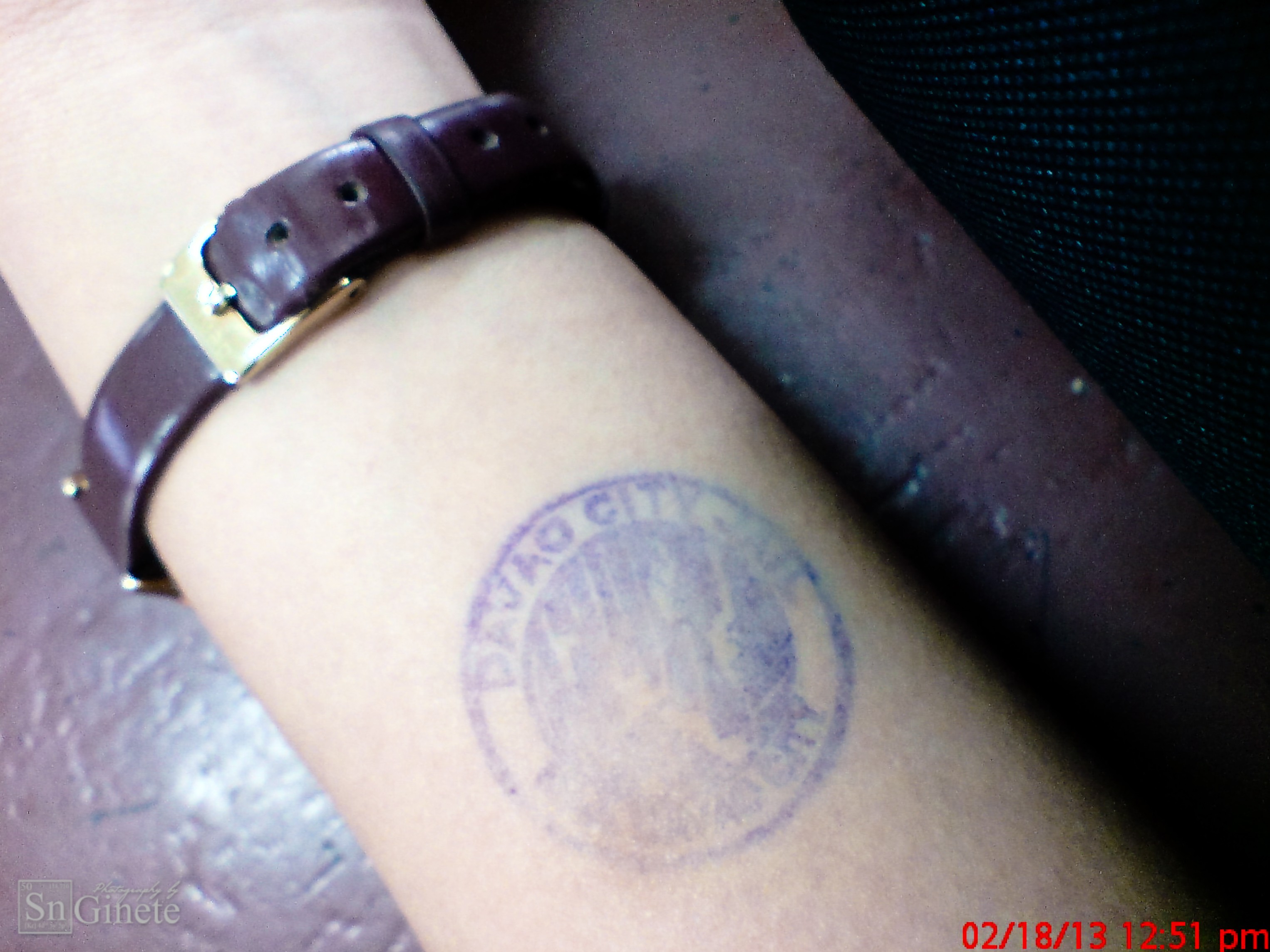
Davao City Jail
Davao City Jail

No. I wasn’t arrested. Just in case you are wondering. 🙂

It was my first time being in jail. I was nervous. I have always thought of prisons in a very negative manner – a correctional facility for the “bad guys” of society. I expected to see and experience the worst – prisoners taunting us, throwing things while we are looking around, screaming, a dirty environment, and prison cells.

That was before I entered the compound of the Davao City Jail. When I got inside, I was surprised. I saw colourful homes with curtained windows, flowers, plants, trees, and a pavilion with a stage decorated for a program. I saw women sweeping the yard, washing laundry, creating and weaving handicrafts –  it doesn’t look like a jail at all.

Yes, the jail wardens referred to the jail houses as “cottages” and the prisoners as “bakasyonistas” or “tourists.” Their quarters are indeed small cottages, and if you weren’t informed beforehand, you might think that there is a small community inside. Except that the settlers are all women, a correctional facility for female prisoners.

Slowly, I became more comfortable as our guide, who happened to be one of the prisoners also, toured us around and explained what the “bakasyonistas” are doing, what the particular cottages are for, and how the system in that community works. Our purpose for the visit is to learn about how they run the program on ALS or Alternative Learning System as part of the requirements in one of my classes in my graduate study at the University of the Philippines in Diliman.

The ALS aims to provide opportunities for these women to study and learn while inside the facility, to help them earn a living through the income generated from the handicrafts that they have created. As for the younger women, this will be equivalent to a vocational course that would certify them to get decent and promising careers outside when they have served their terms and are released from the facility.

Most of the “bakasyonistas” were detained due to drug-related offenses. Some accounts are based on a drug-busting operation, and they just happen to be included because they were at the scene when the operation happened, but were innocent of the crime. A classmate of mine and I were allowed to interview one “bakasyonista.”

Her name is *Rosa. She is 25 years old, 2 years younger than me. She has two kids already, and she’s been in the facility for almost 2 years. She and her husband were separated even before she was arrested. When I saw her, I never felt any apprehension about how to approach her. She seems harmless.

She greeted us with a smiling face, a bit shy. She carries a very light expression about her while we were conversing. We asked her about how she finds the ALS program and found out that she is one of the staff members in charge of the art decorations of the stage. She said that she loves to do artwork, and she is also one of the women in that community who weaves ladies’ bags out of straw.

She said that it is a very good opportunity for them that they are studying through the ALS because it gives them hope. It gives them another chance to start something good for a new beginning when they leave the facility. I asked her what she plans to do after she has served her term. She said she plans on putting up her own handicraft store, and she wanted to see her two kids, as she missed them so much already.

She said that she seldom sees the kids as they are studying, and her mom and relatives are also too busy to pay her a visit. They get to visit her once or twice a year. I asked her when her term will end. She was silent at first, looked at her hands laid out in front of her, and then she cried.

She doesn’t know how long she will stay inside the facility. In between sobs, she told us she misses her children so badly. Sometimes, even if the facility seems to be a good community and they are treated pretty well, it still feels lonely.

She said that yes, they may be seeing homes, flowers, plants – a regular community, but at the back of her mind, the thought still remains that they are prisoners. Although they may be free to roam around the compound, they still can’t leave the facility and mingle with the rest of society, free to do anything they want.

At that time, while she was talking, I wanted to cry too. But I just held her hand and listened. By the end of her story, I told her with a smiling face, “Don’t lose hope. Have faith in God. He will give you the strength to overcome all those feelings of loneliness and hopelessness. You will get out of this facility, you will be free, and you will be able to see your children soon.”

I changed the topic as soon as I said that to keep her from crying even more. I asked her what she did on Valentine’s Day. She told us that she was one of the “bakasyonistas” who conceptualized the theme for the stage decoration, and yes, she had a date.

After saying this, yes, the light, bubbly *Rosa was back again. I teased her. I asked who the guy was. She told us that the guy is one of the male detainees at the men’s correctional facility, which is the compound next to theirs.

So I wondered how they got to know each other. She said that it was through a dance group, where she and the guy were members, while they were practicing for a dance presentation. After that, they have been sending love letters to each other through a window. She is blushing while saying all these, and I can’t help but feel happy for her.

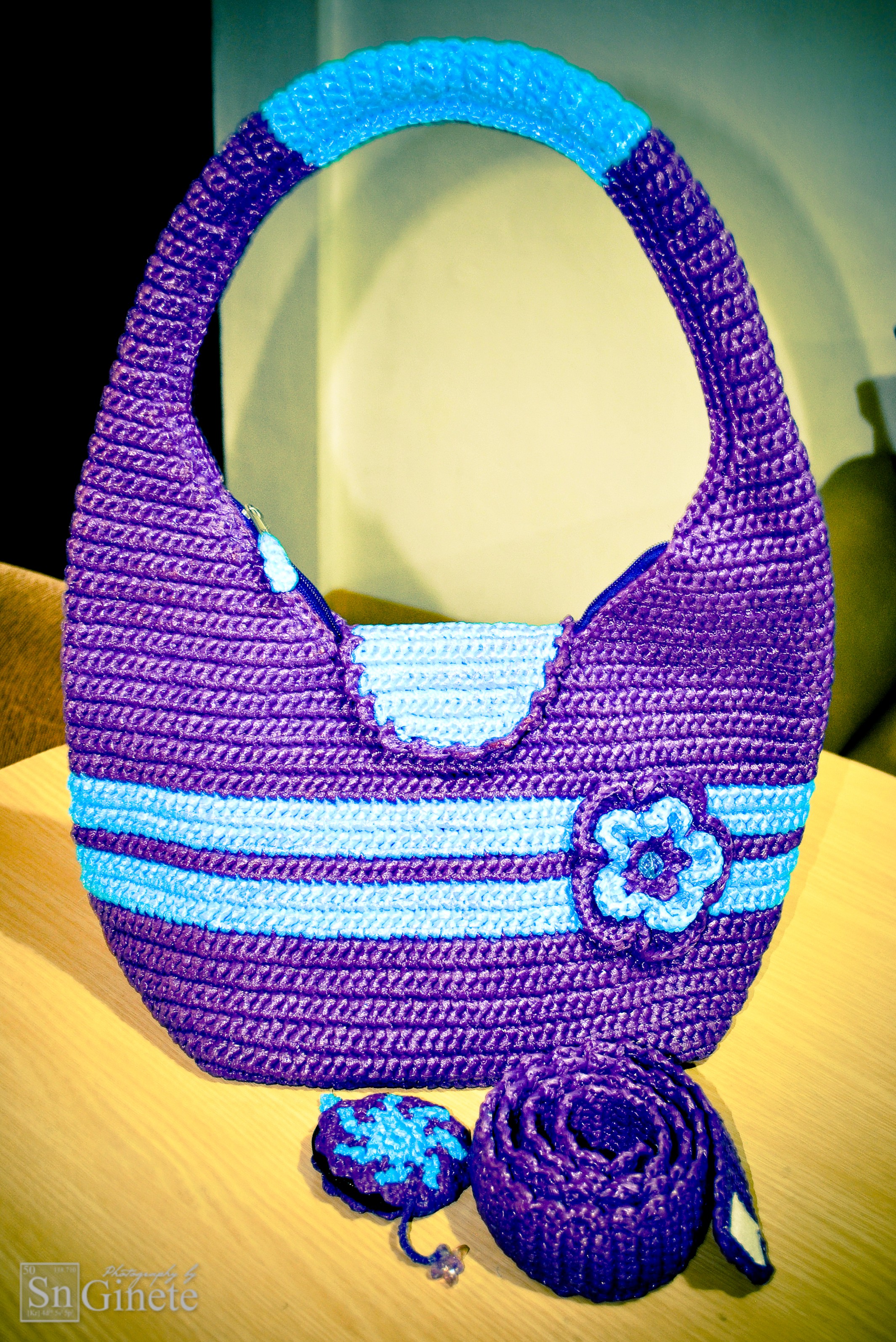
When our professor told us to wrap up the interview, I asked her if she could show me some of the handicrafts she had made. She showed me a purple and blue shoulder bag. Being a fashionista, I liked it right after I saw it. I asked her how much it is. She told me it is worth Php350.00, which is equivalent to US $7. I gave her a 500-peso bill and told her to just keep the change.

I was expecting her to say “Thank you” and only that. But no, she hugged me tight, almost jumping from joy, smiled, and told me, almost crying, how grateful she is. She just could not thank me enough; she told me she would use the money to buy her youngest girl a new pair of school shoes.

She then told me to wait because she had something more for me. I told her it is fine as we are also about to leave. But she still insisted, so I gave in. She returned a few minutes later with a coin purse and a belt made of the same color as the bag I bought. She is giving them to me, for free, so they would match my bag.
Image
*Rosa’s Handwoven Bag, Belt and Coin Purse All Made of Straw

When she said that, it was I who wanted to cry right then and there. It is a good thing I was able to hold my tears. I thanked her and just told her how nice of her to do that, and for having a big heart. I told her that I will never ever forget her.

I asked her how I can contact her. She gave me the number of the facility and her full name. Afterwards, I hugged her tightly again, and she hugged me back just as tightly, smiling with a light and happy heart. Then, I had to bid her farewell.

As I was inside the van with the rest of the class on our way to our dormitel, I began to replay what had just happened. Those few minutes that I got to talk to her, see the community, and hear their stories, I felt like I had learned a year’s worth of experience.

As the facility is starting to get smaller and farther from our view, I can only utter a prayer. A prayer of hope for *Rosa, her children, and her family. A prayer for her that she would continue to look at life from a positive perspective despite what she went through, going through, and her sacrifices. That she would continue to hold on to her dreams despite all the feelings of loneliness, depression, and hopelessness.

Yes, I have faith. I told her to have faith. God is good and loving enough to answer prayers when we repent and ask for His forgiveness. He has a purpose for every single thing that we experience. I told her to be patient. God makes all things beautiful in His time. Just trust and obey.

Lastly, I pray for her heart, that though it may have been broken, though it may have been tainted, it still would remain capable of loving and caring.

It was golden. That moment was golden.

Why I Share

Image

Sharing.

Yes. Inspirations solely come from how we see other people and what we see from other people – by what they share and by what they do.

It is neither for popularity, for awards, nor recognition that’s why I post and write articles in my blogs and websites. I do acknowledge the awards as a courtesy to those who have appreciated and recognized my works. My sincerest gratitude goes out to them. The same thing when I post photos and statuses over Facebook or any other social networking sites.  The ‘likes’ are highly appreciated but I just regard them as an added bonus to my main purpose – to SHARE interests  and thoughts, to make CONNECTIONS with people who share the same passion and ideas that I may have and ENCOURAGE those who don’t by giving them something new to learn, something new to try and something new to discover.

People have different interpretations of what they see. There are pros and cons when an idea is laid out in the open for the entire world to see. A single thought can spark a gazillion feedback and ideas. Yes, I am speaking of an issue going viral especially on the internet, nowadays. There are issues that fueled debates, some got conclusions, while some are still, yes – heated debates. A certain post, a certain idea, a certain action can either turn you into a hero or a victim of cyber bullying. That is why sharing will require someone to sum up great courage and patience.

We, writers, are often misunderstood. There are times when by sharing, we gain more detractors than supporters. But I take it on a positive and light note. It indicates that they have pondered upon your thoughts to come up with their own interpretation even if it means contradicting yours. It is, in fact, good. That is freedom of expression and it is everybody’s right. Democracy, in other words. The same way I have exercised this freedom through writing and letting the world know what I have in mind.

By sharing, you give your interpretation of the world to the world. You are giving another option for people to think about. The more options we have, the broader our knowledge becomes. When we think on a wider perspective, we become more accepting, more understanding, we learn to respect. Sharing what is good will harbour good responses. Sharing the negative ones will create a negative atmosphere. Just like what we see on televisions nowadays. Violence will foster violence and harmony will foster peace.

But it is not always the one side of a coin that people should know about. They needed to see the other side too. They needed to be informed, they needed to be warned. That’s when a writer starts trusting his/her instincts what is highly relevant from what is not and be responsible about sharing so as not to create a negative atmosphere and promote a negative value through his/her post.

At the end of the day, it is good to reflect on the comments, suggestions and insights of other people, the good and the bad ones. But at the end of it all too, you have to go back to the very reason why you posted that idea, that thought. It will refrain you from thinking negatively and reacting negatively. You have to remember that you needed to SHARE – to provide another insight, learn other insights too and INSPIRE other people.

“I Volunteer!”

Image

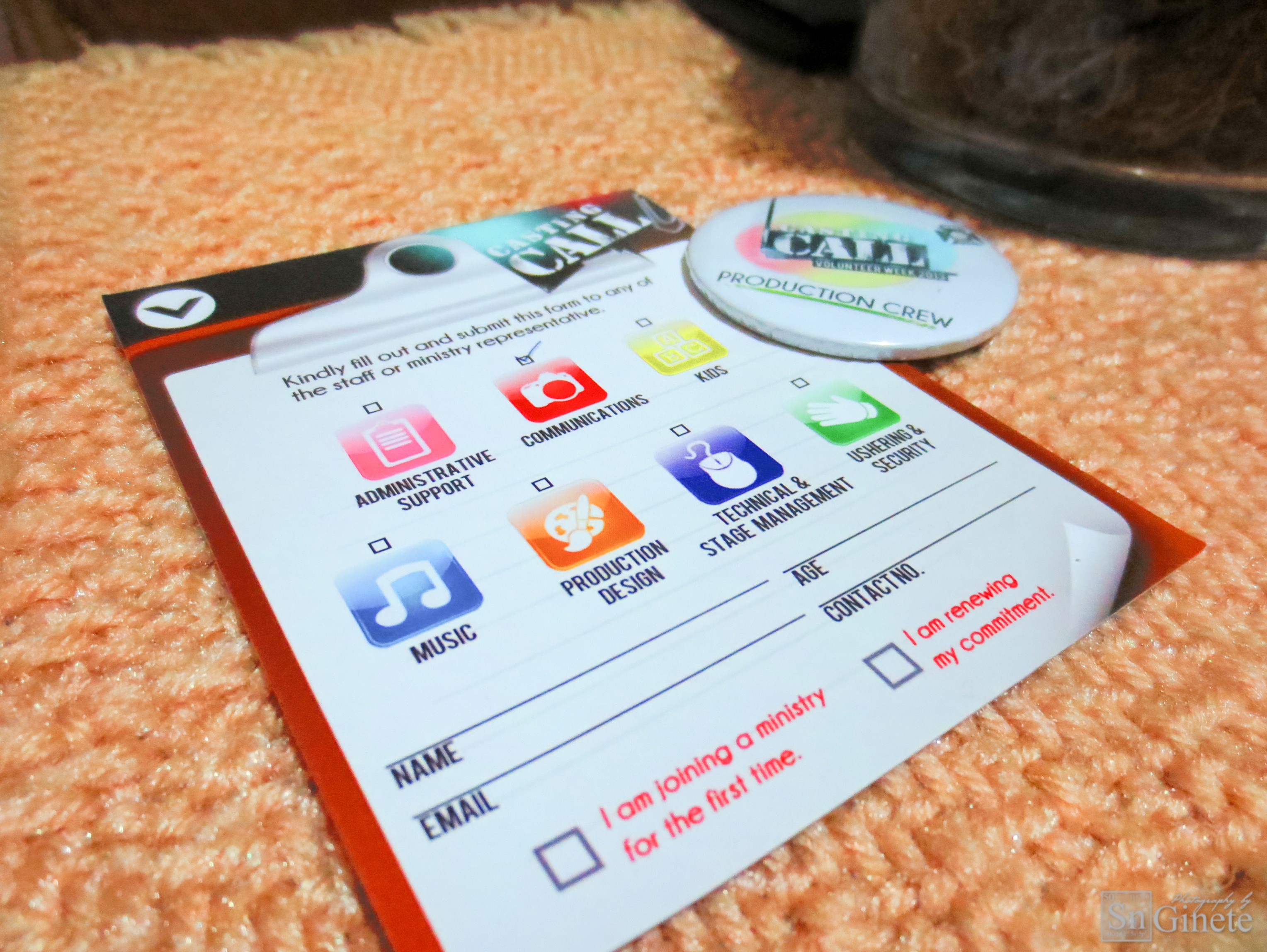
Yep, I am joining in. 🙂

I checked one of the little boxes right up there. Most probably you’re going to ask, why Communications Ministry? I, myself, don’t even have the slightest idea why I chose that when it wasn’t even part of the 3 ministries that I am choosing from – Kids Ministry, Music Ministry and Admin Support.

All I could remember was my hand and my pen gravitating toward the box beside Communications Ministry when Pastor Dan started counting down during the worship service the Sunday before last Sunday saying, “Okay, you have 10 more seconds left to decide where you want to volunteer.” I just stared at the check mark after checking the box contemplating why.

But I did not dare change it. Again, I don’t know why. Until I submitted the form. I can neither ask God why. For I know not what the plans He has for me. But if this is my calling, then, I would definitely accept it. Wholeheartedly. 🙂

As with any obligation, responsibility and form of volunteerism, commitment is the key in providing a successful and fulfilling service. I only have one prayer at this point – may God guide me so I would be able to stay committed and focused with this new endeavor and be able to serve His purpose.

All for You, Father God. All for You. 🙂

On Pedagogy and Its Hidden Curriculum

Image

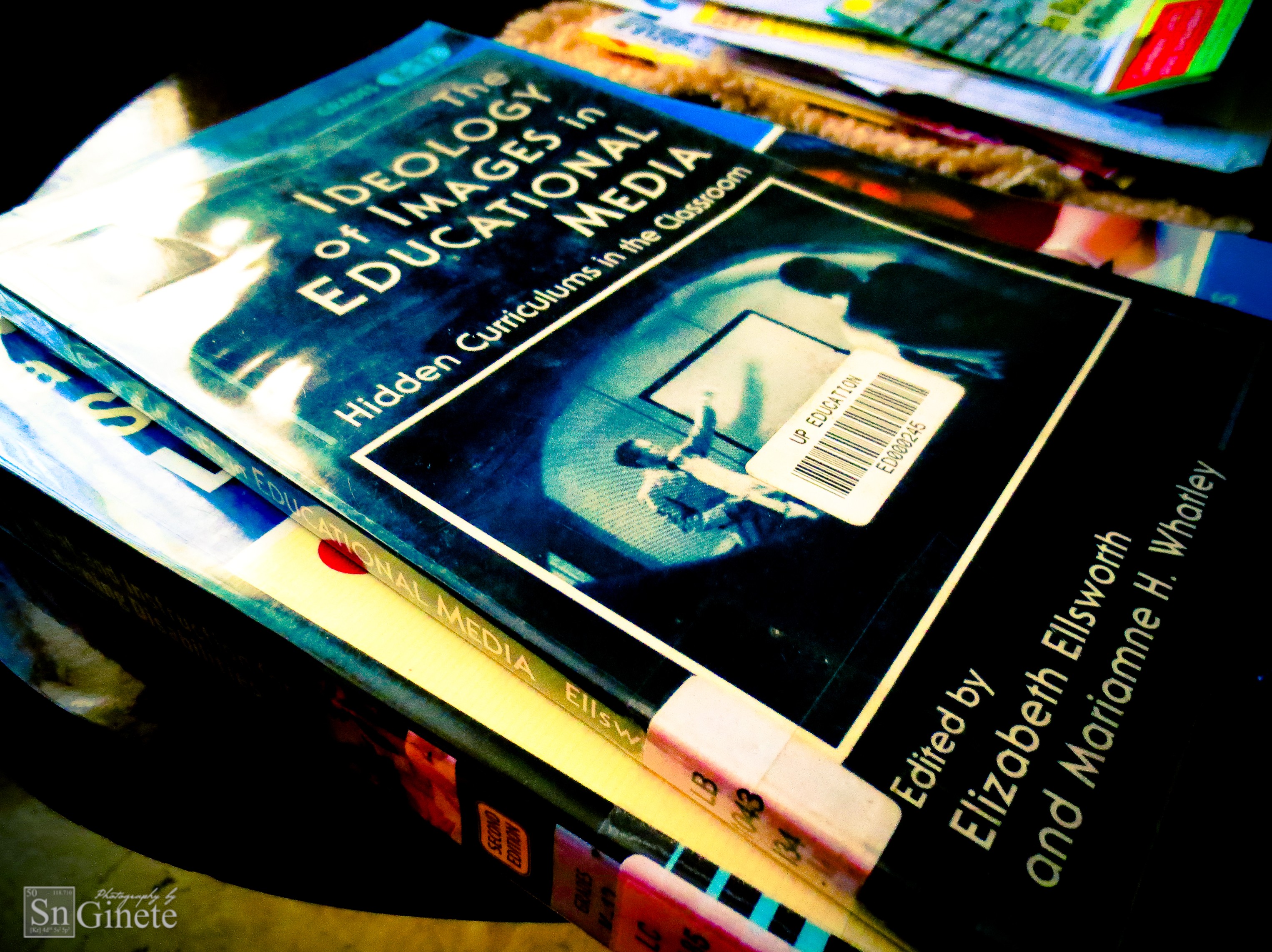
“Hidden Curriculums in the Classroom”

As a blogger, future SPED practitioner and educator, I believe it is my obligation to inform what goes on inside the academe and be critical about its practices. This was a reflection paper I submitted in one of my classes in my grad study.

First things first, let’s define some terms. What is hidden curriculum? As defined in the article entitled “The Hidden Curriculum and Social Studies,”

“The hidden curriculum, what was once referred by John Dewey as “collateral learning,” consists of all learnings that take place in school as a result of actions by school personnel and students. These learnings are normally excluded from statements of what is to be learned through the formal program of studies specified in each school or school district.”

I have found quite a number of issues that prevail until now in our current educational system most especially in public schools. I have been a “public school baby” since Grade 1 until now. I have seen how the traditional system works, how it is applied and what are its effects to the entire student population, me included. In the article entitled “Schools Kill Curiosity: The Regime of Conformity and Obedience,” I would have to admit that yes, most of what was discussed are all true and these situations do happen in our educational system. In the traditional system of instructing students, for example, it is only the teacher who talks in front of the class while the students are listening. And for the entire duration of the discussion, the students never get to interact and share their opinions. Thus, they have this notion that what teacher and the book say, are all true, correct and valid and most of all, students have to conform to how they were taught in the classroom.  This method became the norm, sadly, to most institutions.

In the article entitled “Hidden Curriculum and Social Studies” what is stated about Social Studies being taught in a mechanistic way has been true to most schools. It is taught by a teacher who would just read what was written on the textbooks, instruct students to memorize the important dates in the history of the Philippine constitution without stressing on its social relevance and how significant was those dates to social change, and would ask them to copy everything that was written on the board. In that instance, all that the students will learn was the notion that studying is all about memorization and dictations, which, stifle the growth of learning of a child. How? It doesn’t allow the students to be creative, to exert their freedom of expression and to be confident in themselves regarding the things that they can share. They become, as what the previous article has stated, “more cautious and less innovative.” It freezes the learning capacity of the child disabling him/her to use potentials not to the maximum but only to a limited extent.

One article has stated about “control as conformity and obedience” inside most of the classrooms. We view the teacher as the one who is in control, the figure of authority and gets to decide on all the matters in class. Yes, I do agree that teachers do have to retain that authority in the classroom to foster the values of obedience, discipline and respect. But I also believe that there is another way in enforcing them, which is yes, through classroom management. I agree that when you teach the students how to be responsible for their actions and for their thoughts, you teach them how to have that sense of self-concept and be more relenting to the classroom policies when you give them the opportunity and the freedom to make their own decisions. Being able to address the issues by talking it out to them establishes that teacher-student rapport wherein the students become more open to how they feel and they know that there is always that other side of the coin in every situation.

As for Social Studies being used as the best form to exercise the benefits of the hidden curriculum, yes, I totally agree with it. If I am to relate it in the Philippine setting, the Social Studies textbooks didn’t fall short in informing the students regarding the Philippine history and its culture. Minorities such as the “Aetas” and the “Igorots” are described in some textbooks. I cannot speak for all though, as I would be relating this to my own experience when I was a grade school student. Although I also believe that only selected minority groups were included in the textbooks, which, I think is not sufficient in promoting and raising that social awareness, culture wise. I must agree that there is indeed so much to learn in Social Studies as the texts really do convey hidden meanings/messages that cannot be learned technically but only through experience by acting these concepts out. Values, most especially. That is, I guess, one of the most important issues that a hidden curriculum provides to its students. When students become socially aware and the teacher was able to make the students relate to their environment and/or society, only then can the students realize the essence of his/her relationship towards and with that society.

When people ask me why I have decided to be a teacher, I only have one answer. I have seen too much in the educational system from instructional and classroom policies to governance which made me decide that there is so much to change inside the classroom and the educational system in general – a vision that has always been the dilemma of current educators and the educators before me. Breaking into the system is as difficult as preventing one’s self from being “eaten” by the system and resistance will always be there.

But if there is one key value that I have also learned in our educational system, academics, social and political wise, it would be resiliency. To be resilient and be affirmative in what you believe in – conform if the situation ushers towards a positive change and remain firm in pushing through what is best for all. Too much of an idealist is negative in a lot of ways especially if what you aim at is a major and social change but changes will and will happen no matter how small or big it is and no matter how difficult it is to implement.

Minsan Ba Naisip Mo Paano Kung Naging Tulad Ka Nila?

(This article was published at the Definitely Filipino website and at the Philippine News RSS Feeds Portal.)

http://definitelyfilipino.com/blog/2012/10/24/minsan-ba-naisip-mo-paano-kung-naging-tulad-ka-nila/

http://news.modelsorg.com/minsan-ba-naisip-mo-paano-kung-naging-tulad-ka-nila/

Image

Inakala ko na sapat na ang makakuha ng magandang marka (1.75, 1.5, 1.25 maging Uno) sa aking mga klase. Sa tuwing nakikita ko ang mga ito, hindi maikakailang ako ay masaya. Dahil nagbunga ang aking sakripisyo, tiyaga at pagpupursigi. Ngunit kaakibat ng kasiyahang ito ang isang malaking responsibilidad.

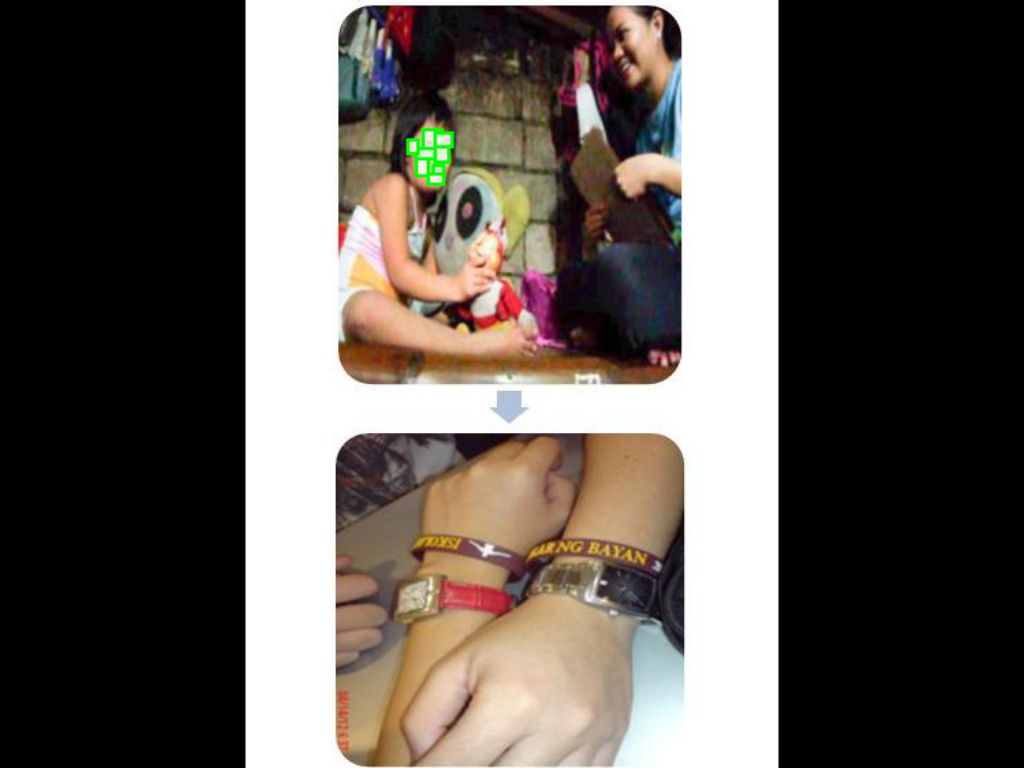
Inatasan ako ng lipunan at ng Unibersidad ng Pilipinas upang tumulong sa lipunan bilang isang Iskolar ng Bayan. Sa pagkakataong ito, dito ko maibabahagi ang aking naging isang karanasan.

Nakilala ko si “D.” Isang batang may kapansanan. Salat sa lahat ng uri ng karangyaan sa buhay. Maswerte na siya kung sa isang araw, tatlong beses silang kumain. Nakatira sila sa isang bahay na maituturing na parang malaking kahon sa liit at sa pagiging marupok nito. Ang kanilang higaan ay isang papag na walang kutson. Ang sahig nila ay lupa, walang semento, walang kahoy.

Nang una ko siyang nakita, isang maaliwalas na ngiti ang ibinati niya sa amin. Niyaya kami papunta sa kama, na ‘yun na din ang nagsilbing kanilang sala. Pagkaupo ko, hinawakan niya kamay ko, at nagtatanong siya. Wala akong maintindihan sa sinabi niya. Pinaulit ko sa kaniya, di ko pa rin maintindihan. Nakita ko kung gaano naging desperado ang bata para mapaintindi ang ninanais niyang sabihin. Ngumiti na lang ako sa kanya at tinanong ko kung ano madalas niyang nilalaro. Kinuha niya ang isang sirang hoola hoop at pinakita sa akin. Dagdag ng Ate niya,

“Yan po ang paborito niyang laruan. Kaso nga lang nasira na.”

Pero hindi ako pumunta doon para kaawaan sila, kundi tumulong. Walang pormal na edukasyon si “D.” At dahil sa kapansanan at kahirapan, mas lalong lumiit ang oportunidad upang mabigyan siya ng sapat at magandang edukasyon. Tinanong ko siya kung gusto ba niya mag-aral, tumango siya sabay ngiti. Napangiti na rin ako, hindi lang dahil sa ngiti niya kundi dahil sa kagustuhan niyang matuto. Masunurin siya at nakukuha niya mga itinuturo ko sa kaniya. Ngunit alam ko na nangangailangan ng mahabang panahon para matulungan siyang makapagsalita, makapagbasa at makapagsulat. Siya ay sampung taong gulang na.

Natapos na ang panahon para makasama ko sila. Isang bagong hoola hoop ang iniwan naming alaala sa kanya at mga prutas na dali dali namang naubos ng magkakapatid. Wala man silang naipamahaging materyal na bagay para maalala namin sila, ang kasulatang ito ay sapat na upang magsilbing alaala ko kay “D.”

Nalalapit na ang huling serye ng aking pagtutuos sa aking pag-aaral bilang estudyante ng SPED. Alam kong hindi sapat na makakuha ng magandang marka. Ang mahalaga, kung paano magagamit ang iyong natutunan para makatulong. Nariyan na ang mga katanungang madalas kong banggitin sa aking sarili: Makakayanan ko ba ang ganitong uri ng trabaho at mga balakid na aking makakaharap bilang isang guro ng mga batang may kapansanan? Maibibigay ko ba ang tulong na kinakakailangan ng mga batang ito? Ilang “D” pa kaya ang maaari kong tulungan?

Sa bawat lagok ko ng Starbucks coffee; sa pagpunta kung saan-saang tourist destinations; sa pagbili ng usong damit, sapatos, bag, gadyet,; sa pagkain ko sa mga fine dining restos at sa lahat ng maituturing nating “extravagance for the privileged”; isa lang ang madalas kong maisip: sana nae-enjoy din ng mga batang tulad ni “D” ang ganitong mga pagkakataon.

Iskolar ng Bayan, ako’y naturingan. Hindi ito nangangahulugang gawing marangya ang buhay at kalimutan ang mga nangangailangan kundi tulungan ang sarili makabangon, maging mabuting ehemplo at magsilbi sa bayan.

Ito ang adhikain ko. Sana ganyan din ang adhikain mo, kaibigan. At ng karamihan.