Throwback sa Buhay Kolehiyala sa Peyups: A Letter to the Graduates

Hindi man makabagbag damdamin ang aking karanasan sa kolehiyo bilang iskolar ng bayan, nais ko pa rin itong ibahagi bilang pagpupugay sa mga magsisipagtapos ngayong darating na Linggo and because I went through a similar ordeal 10 years ago.

It took me 2 years to finish my undergraduate thesis. Sabi ng iba mahirap daw makapasok ng UP at ‘di hamak na mas mahirap daw ang lumabas. Kasama na ako sa maliit na porsyento ng mga Isko at Iska na sumasangayon sa kasabihang iyan. Ngunit ano pa mang karanasan ang danasin nyo sa unibersidad, kailangan nyong alalahanin na the role of the university is only to prepare you for the outside world. In my case, muntik man akong naging dropout at na-delayed ng 2 years, naintindihan ko ngayon na will pa rin ng Dios na grumadweyt ako. Pero kung sakali mang hindi, alam ko rin na God has better plans for me na Sya lang ang nakakaalam – God’s timeline and not mine; God’s plans and not mine.

Ika nga, “Many are the plans of man but it is the Lord’s purpose that will prevail.” – Proverbs 19:21

To be able to graduate from college was both a trial and a journey of faith meant to mold us to who God wants us to become. And yet you will encounter more trials wherein the world will ask you to conform to its patterns and standards and deviate from your faith. Your heart will be tested when choosing between what is right and what is wrong sa mata ng Panginoon. You will rise and fall along the way. Your priorities will change as seasons shift. You will weigh opportunities that could’ve made you look great in the eyes of the world, but will leave you feeling empty and with a corrupted soul. And you will be torn between pleasing this world or pleasing the Lord, your God.

If we were given wisdom, it is not for the sole purpose of just gaining knowledge. If we were given power and influence, it is not to prove how mighty and popular we can be. If we were given provisions, it is not so we can be secured with our future. They were not given so we can use them according to our ambitions and wants, but they were given so we can glorify God’s name, His will, and His plans.

“Who is wise and understanding among you? Let them show it by their good life, by deeds done in the humility that comes from wisdom.” – James 3:13 

“Do not deceive yourselves. If any of you think you are wise by the standards of this age, you should become “fools” so that you may become wise.” – 1 Corinthians 3:18

“Wisdom’s instruction is to fear the Lord,
and humility comes before honor.” – Proverbs 15:33

UP, with its diversified community and culture, has taught me the value of freedom by being a nonconformist, and yet it is faith which taught me that it is God whom I should please by not conforming to the patterns of this world.

Through the bittersweet memories with our UP Naming Mahal, I took an oath to serve God, serve my family, and serve the country not through the standards of this world but through God’s standards.

Lastly, why God?

“Yes, I am the vine; you are the branches. Those who remain in me, and I in them, will produce much fruit for APART FROM ME YOU CAN DO NOTHING.” – John 15:5

“And what do you benefit if you gain the whole world but lose your own soul? Is anything worth more than your soul?” – Matthew 16: 26

As you embark on yet another season in your life, may you not depart from the greatest wisdom of all time, wisdom that is even greater than what the academe has taught you – God’s Word.

Praying with you in faith,

Christine Lailani G. Ginete-Rome ❤

GradPhoto

BA English Studies major in Literature, College of Arts and Letters, UP Diliman (04/28/2008)

Classics: Of Reading and Writing

While fixing my stuff, I came across an old textbook of mine we used way back undergraduate days. I browsed through it and while flipping its pages, something caught my eye. It was an excerpt and then I found yet another excerpt from major names in the field of literature. Beautiful essays, they are. I thought I’d share it with you just to have an idea where my passion for reading and writing came from. But in intellectual discussions and conversations, I merely listen. I listen, then I write. 😉

getty_francis_bacon

Engraving of Sir Francis Bacon (1561-1626), English philosopher, writer, lawyer, and statesman. His philosophy of science concerning the use of inductive reasoning for scientific inquiry had a significant influence on later scientific methods of investigation.

OF STUDIES by Francis Bacon (excerpt)

Studies serve for delight, for ornament, and for ability. Their chief use for delight is in privateness and retiring; for ornament, is in discourse; and for ability, is in the judgment and disposition of business. For expert men can execute, and perhaps judge of particulars, one by one; but the general counsels, and the plots and marshalling of affairs, come best from those that are learned. To spend too much time in studies is sloth; to use them too much for ornament, is affectation; to make judgment wholly by their rules, is the humor of a scholar. They perfect nature, and are perfected by experience: for natural abilities are like natural plants, that need pruning, by study; and studies themselves do give forth directions too much at large, except they be bounded in by experience. Crafty men condemn studies, simple men admire them, and wise men use them; for they teach not their own use; but that is a wisdom without them, and above them, won by observation. Read not to contradict and confute; nor to believe and take for granted; nor to find talk and discourse; but to weigh and consider. Some books are to be tasted, others to be swallowed, and some few to be chewed and digested; that is, some books are to be read only in parts; others to be read, but not curiously; and some few to be read wholly, and with diligence and attention. Some books also may be read by deputy, and extracts made of them by others; but that would be only in the less important arguments, and the meaner sort of books, else distilled books are like common distilled waters, flashy things. Reading maketh a full man; conference a ready man; and writing an exact man. And therefore, if a man write little, he had need have a great memory; if he confer little, he had need have a present wit: and if he read little, he had need have much cunning, to seem to know that he doth not. Histories make men wise; poets witty; the mathematics subtle; natural philosophy deep; moral grave; logic and rhetoric able to contend. Abeunt studia in mores [Studies pass into and influence manners]. Nay, there is no stone or impediment in the wit but may be wrought out by fit studies; like as diseases of the body may have appropriate exercises. Bowling is good for the stone and reins; shooting for the lungs and breast; gentle walking for the stomach; riding for the head; and the like. So if a man’s wit be wandering, let him study the mathematics; for in demonstrations, if his wit be called away never so little, he must begin again. If his wit be not apt to distinguish or find differences, let him study the Schoolmen; for they are cymini sectores [splitters of hairs]. If he be not apt to beat over matters, and to call up one thing to prove and illustrate another, let him study the lawyers’ cases. So every defect of the mind may have a special receipt.

WHAT IS A CLASSIC? by Charles Augustin Saint-Beuve (excerpt)

A true classic, as I should like to hear it defined, is an author who has enriched the human mind, increased its treasure, and caused it to advance a step; who has discovered some moral and not equivocal truth, or revealed some eternal passion in that heart where all seemed known and discovered; who has expressed his thought, observation, or invention, in no matter what form, only provided it be broad and great, refined and sensible, sane and beautiful in itself; who has spoken to all in his own peculiar style, a style which is found to be also that of the whole world, a style new without neologism, new and old, easily contemporary with all time.

This last one was my professor’s paraphrased version of Francis Bacon’s “Of Studies.”  I loved her own style in rewriting it.

Of Studies by Francis Bacon

Studies are for amusement, for showing off one’s education in social institutions and for getting along with skill. For the purpose of amusement, studies are for occupying one’s private, leisure moments. For social situations, studies will allow one to show off how well he can engage in conversations. Studies can also help one make the right decisions, but only within each one’s limited field of expertise. But for more extensive advice and ideas on how to manage in different situations, the advice of the learned may be taken from different readings.

To spend all of one’s time doing nothing but studying is a form of laziness.To display how well-read one is in conversations is a form of pretentiousness or vanity. But to base one’s judgment on what one has learned from reading is all at the same time the sudden whim, the source of excitement and activity and usual habit of a scholar.

The writings of learned men show a way of improving oneself. These writings contain good advice which have been derived from experiences. The natural tendencies and abilities of man may be improved, disciplined or controlled by the knowledge gained from reading. Studies serve as a tool for self-discipline in the same way that pruning makes a plant grow better. Readings in themselves may give too many ideas, directions or advice. But they are to be taken according to how they have been used according to the writer’s experience and according to to how they can be used according to the readers’experiences.

Cunning men look down on what they read. They do not generally put a value on reading. Men of lesser intelligence admire what they read. Readings do not limit their value to teaching how valuable they are or how useful they are. Instead, they teach lessons and even encourage readers to observe and discover truths beyond those contained in the readings themselves.

Do not read only to argue against and disagree with everything that has been read. But do not accept and believe everything that has been read. Do not read for the sake of finding something that can be talked about. Read to understand and consider the value of what was read.

Books are food for the mind – some are to be tasted, meaning, read only its parts; some are to be swallowed, meaning they should be completely read without thinking deeply about their contents; and some books are to be chewed and digested, meaning they should be carefully analyzed, understood and appreciated. Books may sometimes be read through digests, summaries or commentaries prepared by others, but these are good only for less important ideas and works. Not reading a book completely and directly, and relying only on the summaries made by others deprive the reader of the full flavor, full essence and full mental nourishment that can be had from a thorough reading of the work. This can be compared to drinking distilled water, which is purified or strained. It is still essentially water, but all the flavor and mix of mineral elements are missing.

Reading makes a man well-rounded or well-developed. Discussion makes him alert and responsive. Writing makes him an accurate and critical thinker.

Sources:

http://grammar.about.com/od/60essays/a/studiesessay.htm

http://www.bartleby.com/32/202.html

Communication Skills, UP Open University

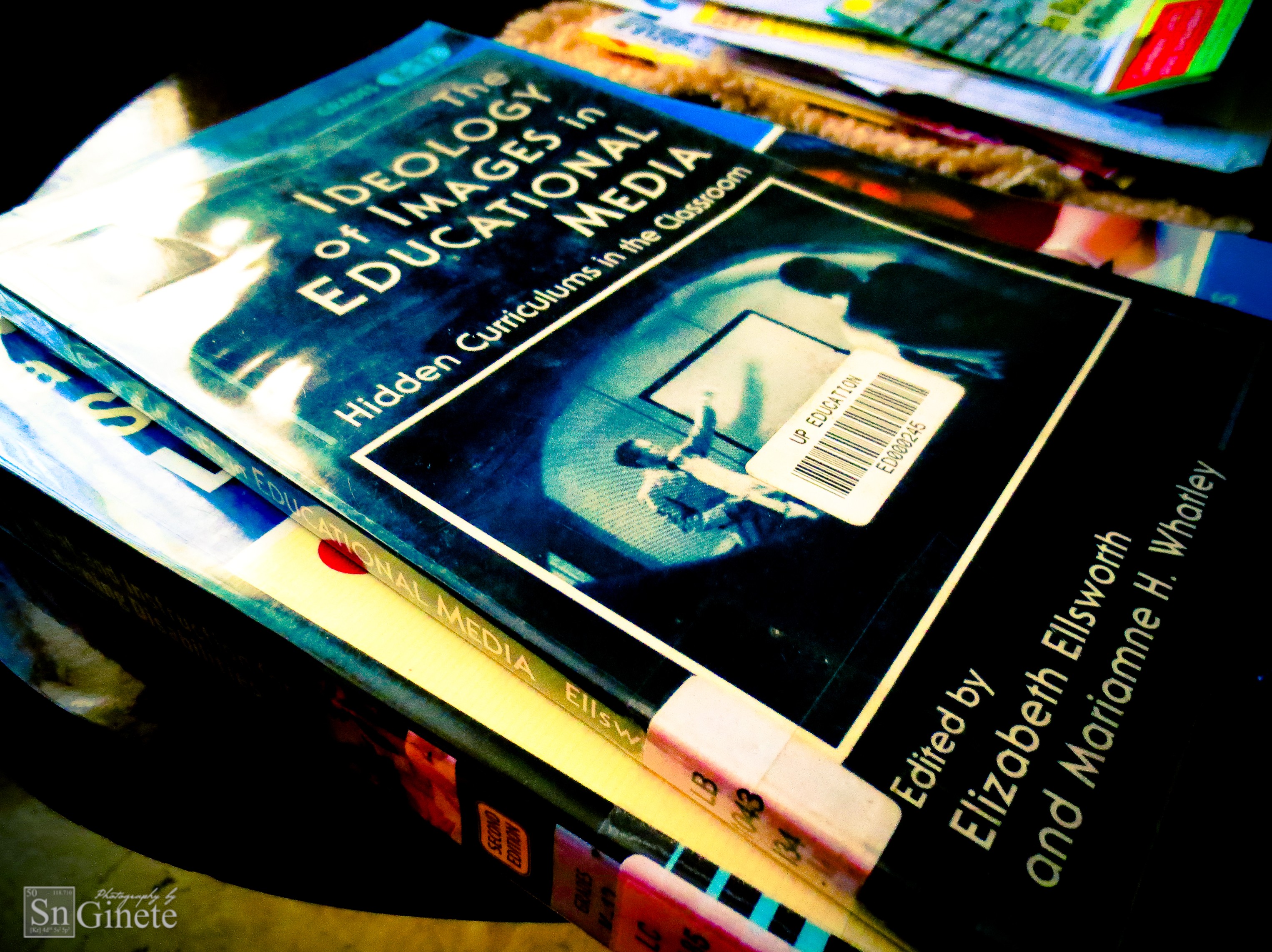
On Pedagogy and Its Hidden Curriculum

Image

“Hidden Curriculums in the Classroom”

As a blogger, future SPED practitioner and educator, I believe it is my obligation to inform what goes on inside the academe and be critical about its practices. This was a reflection paper I submitted in one of my classes in my grad study.

First things first, let’s define some terms. What is hidden curriculum? As defined in the article entitled “The Hidden Curriculum and Social Studies,”

“The hidden curriculum, what was once referred by John Dewey as “collateral learning,” consists of all learnings that take place in school as a result of actions by school personnel and students. These learnings are normally excluded from statements of what is to be learned through the formal program of studies specified in each school or school district.”

I have found quite a number of issues that prevail until now in our current educational system most especially in public schools. I have been a “public school baby” since Grade 1 until now. I have seen how the traditional system works, how it is applied and what are its effects to the entire student population, me included. In the article entitled “Schools Kill Curiosity: The Regime of Conformity and Obedience,” I would have to admit that yes, most of what was discussed are all true and these situations do happen in our educational system. In the traditional system of instructing students, for example, it is only the teacher who talks in front of the class while the students are listening. And for the entire duration of the discussion, the students never get to interact and share their opinions. Thus, they have this notion that what teacher and the book say, are all true, correct and valid and most of all, students have to conform to how they were taught in the classroom.  This method became the norm, sadly, to most institutions.

In the article entitled “Hidden Curriculum and Social Studies” what is stated about Social Studies being taught in a mechanistic way has been true to most schools. It is taught by a teacher who would just read what was written on the textbooks, instruct students to memorize the important dates in the history of the Philippine constitution without stressing on its social relevance and how significant was those dates to social change, and would ask them to copy everything that was written on the board. In that instance, all that the students will learn was the notion that studying is all about memorization and dictations, which, stifle the growth of learning of a child. How? It doesn’t allow the students to be creative, to exert their freedom of expression and to be confident in themselves regarding the things that they can share. They become, as what the previous article has stated, “more cautious and less innovative.” It freezes the learning capacity of the child disabling him/her to use potentials not to the maximum but only to a limited extent.

One article has stated about “control as conformity and obedience” inside most of the classrooms. We view the teacher as the one who is in control, the figure of authority and gets to decide on all the matters in class. Yes, I do agree that teachers do have to retain that authority in the classroom to foster the values of obedience, discipline and respect. But I also believe that there is another way in enforcing them, which is yes, through classroom management. I agree that when you teach the students how to be responsible for their actions and for their thoughts, you teach them how to have that sense of self-concept and be more relenting to the classroom policies when you give them the opportunity and the freedom to make their own decisions. Being able to address the issues by talking it out to them establishes that teacher-student rapport wherein the students become more open to how they feel and they know that there is always that other side of the coin in every situation.

As for Social Studies being used as the best form to exercise the benefits of the hidden curriculum, yes, I totally agree with it. If I am to relate it in the Philippine setting, the Social Studies textbooks didn’t fall short in informing the students regarding the Philippine history and its culture. Minorities such as the “Aetas” and the “Igorots” are described in some textbooks. I cannot speak for all though, as I would be relating this to my own experience when I was a grade school student. Although I also believe that only selected minority groups were included in the textbooks, which, I think is not sufficient in promoting and raising that social awareness, culture wise. I must agree that there is indeed so much to learn in Social Studies as the texts really do convey hidden meanings/messages that cannot be learned technically but only through experience by acting these concepts out. Values, most especially. That is, I guess, one of the most important issues that a hidden curriculum provides to its students. When students become socially aware and the teacher was able to make the students relate to their environment and/or society, only then can the students realize the essence of his/her relationship towards and with that society.

When people ask me why I have decided to be a teacher, I only have one answer. I have seen too much in the educational system from instructional and classroom policies to governance which made me decide that there is so much to change inside the classroom and the educational system in general – a vision that has always been the dilemma of current educators and the educators before me. Breaking into the system is as difficult as preventing one’s self from being “eaten” by the system and resistance will always be there.

But if there is one key value that I have also learned in our educational system, academics, social and political wise, it would be resiliency. To be resilient and be affirmative in what you believe in – conform if the situation ushers towards a positive change and remain firm in pushing through what is best for all. Too much of an idealist is negative in a lot of ways especially if what you aim at is a major and social change but changes will and will happen no matter how small or big it is and no matter how difficult it is to implement.