Hello, my dearest readers! After a year of hibernation and very busy months, I’m finally posting here on my WordPress blog. This is not a regular blog post, however, as it’s actually one of our requirements in the Social Entrepreneurship online class I’m currently enrolled in at the University of the Philippines Open University. By reading my concept paper, I hope you will be encouraged to take the online course as well and be part of the catalysts for social change.
——————————————————————————————————–
My Vision of a Social Enterprise: WE Rice & Agri
by: Christine Lailani Ginete-Rome, LPT
BACKGROUND & RATIONALE
The social enterprise that my family and I have envisioned to organize one day, God willing, will be called “WE Rice & Agri.” It is derived from the statement, “We rise and agree.” When I was choosing the name for our social enterprise, I thought about what will highlight the main agricultural produce of our family’s agribusiness (rice) in the Bicol region with a subtle note on women empowerment. WE Rice & Agri stands for “Women Empowerment thru Rice and other Agricultural products.”
Why use women’s empowerment for this social enterprise? When the pandemic started in 2020, researchers have identified an alarming increase in the statistics of domestic abuse and violence on women and children. According to an article by Business Mirror,
[In the report titled, “Covid-19 and Violence against Women: The Evidence Behind the Talk,” UN Women partnered with the United Nations Population Fund (UNFPA) and analytics company Quilt.AI and determined that these online searches surged 63 percent in the Philippines. These online searchers included specific references to “men hitting women,” “spouse abuse,” “boyfriend hit me,” and “controlling men” or “controlling husband.”
There are several studies that can confirm that women in abusive relationships oftentimes do not seek protection or report the incidences of abuse because of several factors. One of them is economic security especially in the case of couples who already have children.
According to an article by the National Network To End Domestic Violence,
“Financial abuse is often cited by victims of abuse as the main reason that they stayed with or returned to an abusive partner…Research indicated that financial abuse occurs in 99% of domestic violence cases. Surveys of survivors reflect that concerns over their ability to provide financially for themselves and their children were one of the top reasons for staying in or returning to an abusive partner. As with all forms of abuse, financial abuse occurs across all socio-economic, educational, and racial and ethnic groups.”
VALUE PROPOSITION
WE Rice & Agri hopes to empower women in the Bicol region to rise up against domestic violence and abuse, provide economic security through livelihood opportunities, and assist in their recovery from the trauma through spiritual mentoring and counseling. The business initiative can also extend to widows and female senior citizens who are still capable of performing light tasks.
The organization seeks to partner with the DSWD and/or international agencies that are advocates of women’s and children’s rights. To aid in the empowerment, counseling, and therapy sessions guided by Biblical principles that will be held once a week, the organization will reach out to churches for volunteers who will be working under the Women’s Outreach Ministry of the organization.
Our agribusiness currently employs around 20-30 farmworkers, but they are comprised of men and mostly the heads of the families. Through our social enterprise, we also hope to provide an alternative source of income to full-time house moms by allowing them to work in the company as part-time workers. We are looking into setting up a daycare center where our women workers can leave their young children while working inside our farm.
DESCRIPTION OF PRODUCTS OR SERVICES
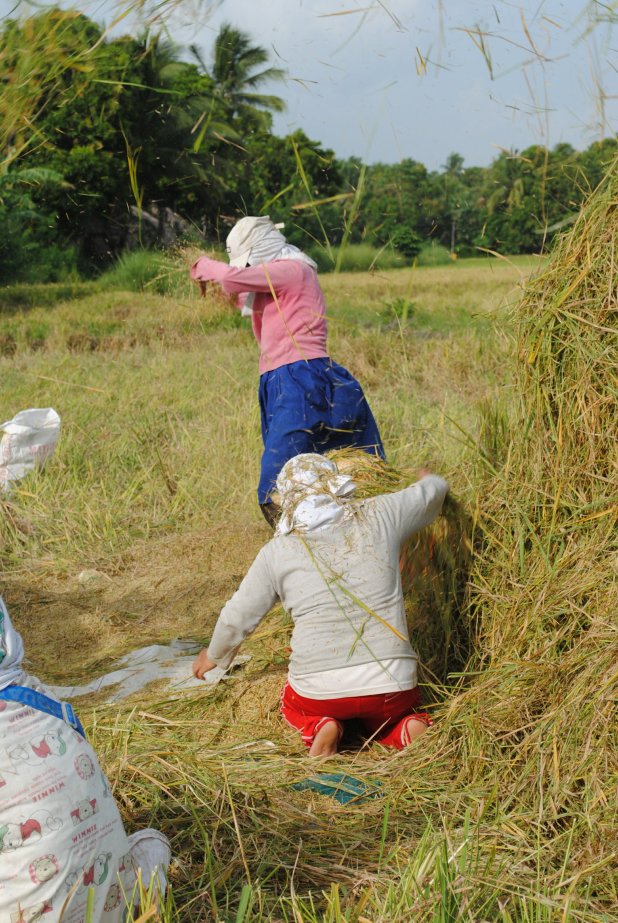
Our family’s agribusiness is a micro-enterprise but we plan to expand our business operations in the future focusing on Climate-Smart Agriculture (CSA) in support of the climate change mitigation efforts being conducted worldwide. We are into copra-making and rice farming for how many generations already starting from my great grandparents, which can be dated back to pre-World War II. Fast forward to 2021, we are now transitioning to innovative approaches in sustainable farming. Our 6.5-hectare farmland is located in Bulan, Sorsogon, wherein 1 hectare is allotted for rice farming and a small portion is used to grow coconut trees for copra.
We are also currently cultivating other rice fields with lot sizes ranging between .8 to 1 hectare located in different areas of the town. Another idle property is located in the town proper, which measures 264 square meters. We are still in the business planning stage on how to utilize it and one of our options is to set up a small store where we will be displaying all the agricultural products for sale. This will help us minimize our operating costs since we no longer need to rent a stall at the public market. The property is also located just a few blocks away from the commercial hub of our town.
There are some portions in one of our properties where we grow bamboos and cacaos but they were only used for personal consumption. We are planning to add organic vegetables and corn to the agricultural products that we would like to sell to the market. The following is the complete list of crops that we have and would like to grow in the future and the possible processed products that will be prepared by our women workers.
- Rice – rice-based pastries or kakanin, rice wine, rice noodles, etc.
- Coconuts – vinegar, tuba, walis tingting, buko juice, coconut husks for gardening compost, uling, etc.
- Bamboo – weaved baskets, bags, mats, hats, other home decors
- Cacao – tablea, other chocolate-based products
- Organic Vegetables – lettuce and other high-value crops through hydroponics/greenhouse farming/mushroom farming
- Corn – sold as raw and/or processed via mini food carts (popped corn, steamed corn, cheese corn, etc.); prepare the husks that can be utilized for industrial purposes i.e. fiber, cattle feeds, etc.
BENEFITS TO STAKEHOLDERS
Gender inequality is included in the 17 Sustainable Development Goals of the United Nations. Stakeholders will not only be supporting a local cause but should the project becomes a success, it will add up to the communities all around the world that address and eliminate gender inequality. The percentage of locally expanding the network for this type of social enterprise is also high since there is only a small number of social enterprises operating using this business model in our region. We hope to encourage more local business owners to follow suit and also become catalysts for social change.
We are also exploring other viable projects for our 6.5-hectare farmland such as developing a portion of it as a sustainable agritourism site. This will provide other means of income and will also serve as a buffer during the typhoon and drought seasons wherein it will be difficult to grow some of the crops needed for the production of the agricultural products listed above. By diversifying our project portfolio, we hope to achieve sustainability in our social enterprise so our women workers will have a consistent income stream.
Consumers will benefit from more affordable prices as raw materials don’t need to be outsourced since our farm will be supplying them. For local buyers, they will now have a wider range of agricultural products to choose from in the market that can be purchased without spending on costly shipping fees.
We are targeting to cater to nearby communities and cities in the region by considering options such as contract farming and as a model farm through the Department of Agriculture’s Agribusiness and Marketing Assistance and by exploring other marketing channels provided by private organizations. The local community will also benefit from environment-friendly farming practices such as agroforestry that will enable the preservation and conservation of local biodiversity and ecosystems.
WE Rice & Agri will act as our company’s forerunner in enriching the lives of the local community in a holistic sense starting from the “ilaw ng mga tahanan” – the beloved mothers.
“Commit to the LORD whatever you do, and He will establish your plans.” - Proverbs 16:3
Padayon by God’s grace,

 The Journeyman's Moments