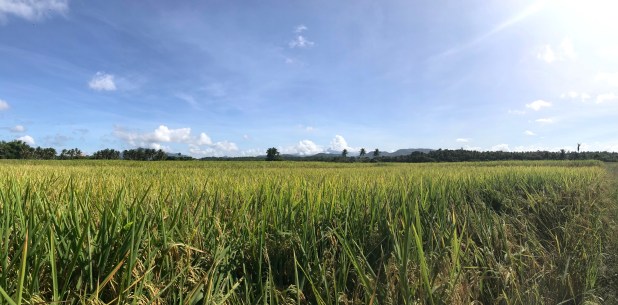
“Halimaw” or “beast” – that’s what our local farm workers would call the harvester. The harvester is just one of the agricultural mechanization upgrades built and designed to make palay harvesting time and cost-efficient.
The downside? Palay harvesting using a harvester simplified the harvesting process, thus, now only required a few farm workers. This means only one thing – we will only hire farm workers who will carry the sacks of palay from the rice fields to the side of the road. They are called here in our local dialect as “parasabak.”
The Process of Palay Harvesting
Before the harvester was invented, there were 3 stages in the palay harvesting process. The first stage is harvesting palay using a sickle, and this usually takes about an entire day. Then it is followed by threshing using a thresher that also takes about one day depending on the size of the rice field. And the last stage involves carrying the sacks of palay to the road.
For shipping and logistics, it will depend on the farmer if he owns a truck that will transport the sacks of palay to the rice dealer or rice miller. Palay producers operating on a macro scale usually own trucks as this will lessen the shipping fees.
But for SMEs (small and medium enterprises) like ours, we coordinate with the rice trader to transport the sacks of palay to their warehouse. There is actually a 4th stage in palay harvesting, which is drying the harvested palay and having them milled before selling the finished product, which is rice, to the market. The selling price of milled, dry rice is higher compared if the farmer sells the palay right after harvesting.
The disadvantage though of the 4th stage is that the unpredictable weather now makes it difficult for palay farmers to sun dry their palay. The profitability of palay relies on two factors – moisture content and yield percentage. The higher the moisture level, the lower the price of palay.
Other Farming “Beasts”
Other “beasts” in palay farming are the tractors, and just recently, the transplanter. My sister was able to talk to another rice farmer who is also a member of the farmers’ association that my Dad is currently a member of. She shared that a transplanter provided by the Department of Agriculture (DA) will be delivered soon and can already be used for the next cropping season. I’d like to commend the efforts of the DA, headed by President Bongbong Marcos, who’s currently the DA Secretary, for their continued efforts to help alleviate the challenges encountered by farmers in general.
The DA has an extensive set of initiatives to ramp up agricultural production, and I will highlight the importance of these initiatives, which will most likely change every year to adapt as we enter a climate emergency. The entrepreneurial mindset of farmers also needs to be tapped to increase their income from selling their agricultural produce. Connecting them to a wide range of markets through public-private partnerships will go a long way to ensure that not a single agricultural product will go to waste, and farmers will get their expected ROI.
So to answer the question is agricultural mechanization here for the better, my answer is “yes.” I guess, it will all depend on the generation of farmers. Because my Dad is a bit apprehensive about trying these new technological advances and innovations as far as agricultural mechanization is concerned.
Personally though, I am all out in trying all these farming innovations as part and in support of the Climate-Smart Agriculture advocacy. For as long as agricultural mechanization remains environment friendly and maintains low carbon emissions, then we maximize utilizing it.
All Hail To Women Farmers
I also noticed that there are now more and more women farmers venturing into agriculture, a popularly identified masculine industry. Now that I get to closely observe how palay production is being done, I must admit that men really do get the upper hand in the agricultural industry. Physical strength is the main component in accomplishing most of the farm tasks.
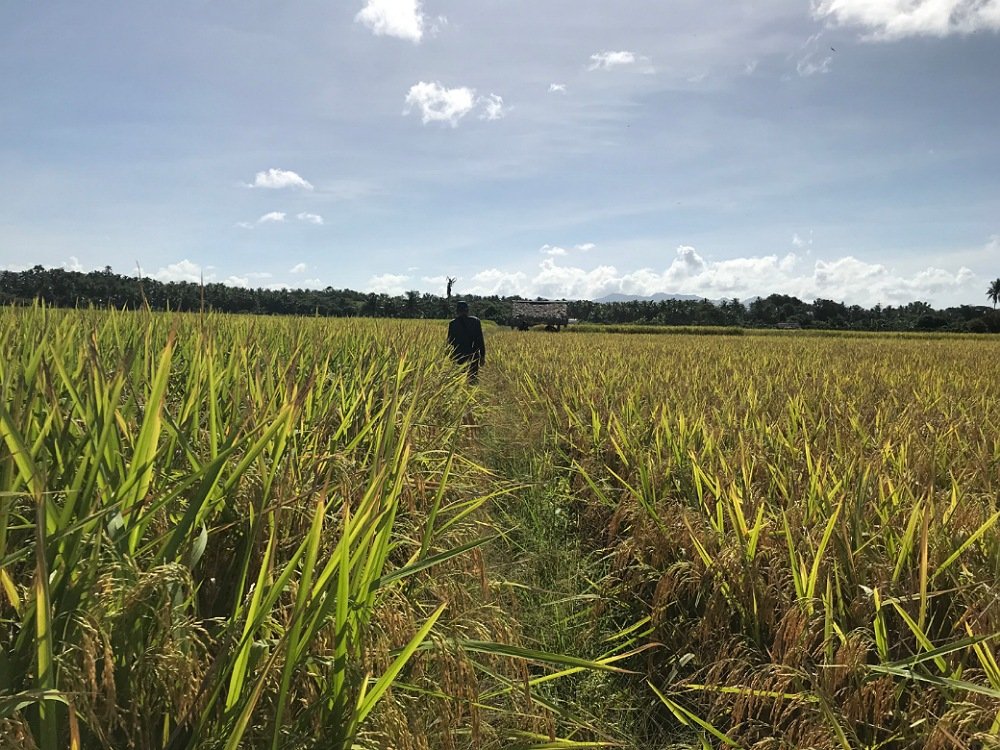
This is something that women, in general, do not have unless we’re Hidilyn Diaz. Agricultural mechanization is somehow the great equalizer in performing farm tasks without any gender bias. I actually want to try operating the harvester if it follows the same mechanism as an ATV. lol Transformers is my favorite movie of all time, so you guessed that right, I like machines.
And yes, my Dad’s a retired Civil Engineer and when I was still a toddler, he would bring me to his office when there was no babysitter. So, I get to snoop around them big trucks when he’s busy signing papers.
What I dislike though being in his office is that when I’m hungry, he would give me Skyflakes for snacks. Uhm, Dad, Skyflakes and toddlers don’t go really well together. But I do love Skyflakes now because they’re actually my “pantawid gutom” during exam days and “hell week” in college.
Why Invest in Agriculture
So, if you’re planning on investing in agriculture, I encourage you to start now even if it’s just a small parcel of land. Agricultural investments are feasible, and they’re a good source of passive income if you have the basic know-how, can hire a farm manager, or have been farming for a couple of years already. There is also a long waiting time between planting and harvesting seasons that will allow you to still have a professional job or side hustles so you can have other sources of income that will serve as your buffer funds.
We need agriculture because it is the only industry that produces food. Without food, it will basically be the end of humanity. This is the part where I’d like to thank and appreciate all of our farm workers who have been our loyal constants for the past decades from one generation to another.
It is my prayer that God will give me and my siblings the wisdom to provide them with more livelihood opportunities in the farming sector so they will also have a continuous source of income to provide for their families. God willing, project diversification might be the solution that we are looking for. And yet, not our will but His will be done always.
So yes, all the zebra stripes that my sister and I got because of the multiple tan lines we have are all worth it. Because if we want to go deeper and get to the core of all the farming issues and challenges that every farmer faces, it really requires that we go out there in the field, figuratively and literally, and get our shoes soiled.
Supporting Local Farming Communities
Another challenge with working in a very masculine industry is people management when the leadership is led by a female. I am observing their responses if they have the social stigma that women should only stay at home, or if they are just plain shy talking to women. 😀 But generally speaking, most of the locals here are good-natured people. Their lives are simple, and yet are rich in genuine connections bound by camaraderie, a true sense of belongingness within the community, and a deep attachment to their environment.
This is also the reason why my approach in managing our farm workers, especially the older ones, is to tell them about a task or a goal, then I ask them how we can accomplish it. I am not a micro manager so I don’t want to hover around our farm workers to see if they are doing the tasks right. I am actually surprised that they know more practical applications that actually work and provide good results.
With this data on hand, farm owners can now incorporate actual data gathered with farming innovations backed by research and conducted by scientists. I believe this is how we bridge the gap between conventional and modern practices – a necessary strategy utilizing this generation’s IoT (Internet of Things), which will in turn provide a more lasting, effective, and promising outcome.
Anyway, I’ll cut this short before it becomes a 100-page thesis. lol If you have any questions regarding palay farming, rice production, and the like, please don’t hesitate to write them down in the comment section below.
As always, “many are the plans of man, but it is the Lord’s purpose that will prevail” (Proverbs 19:21). Thus, let’s “commit our plans to the Lord, so He can direct our steps” (Proverbs 16:3). 🙏
P.S. Speaking of innovations, I am searching for portable and high-quality but affordable coconut graters that can be used at home. Bicolanos love using coconut milk when cooking vegetables and fish viands. Like this Bicolano fish dish called “Taguktok,” which is Dad’s favorite. I already modified it though because I used a different type of fish. We usually use “Buraw” stuffed with green chilis, onions, tomatoes, garlic, and ginger seasoned with salt, vinegar, and pepper. We have a lot of coconuts here at home since we’re also into copra production, but I just don’t know how to grate them manually. This doesn’t make me less of a Bicolana though, does it? 😉

 The Journeyman's Moments